
Accessible pipe repair, $200–$500
A burst you can point at, exposed pipe in a garden, garage or accessible wall, cut out and repaired in business hours.
A burst announces itself somewhere convenient, a ceiling stain, a soggy lawn, and hides somewhere else entirely. We isolate the water, trace the line to the actual failure, and replace the broken section properly. Then it holds a mains-pressure test before a single surface closes. Chifley and the Eastern Suburbs, day or night.
Most of what bursts around Chifley is age meeting pressure. Original copper lines from the mid-century build era wear thin from the inside until a pinhole opens; older galvanised steel rusts until a fitting lets go; and garden poly lines split where a root or a shovel found them years ago. Add mains pressure that runs high across parts of the Eastern Suburbs, and the weakest point eventually announces itself.
The catch is that water travels. It runs along the outside of the pipe, along joists and wall plates, and surfaces somewhere downhill of the actual split, which is why the wet patch on the ceiling is so often metres from the leak. Repairing where the water shows up fixes nothing. We trace the line back to the failure itself, repair that, and pressure-test before closing anything back up.


Corrosion near the water does not stop at the pipe. Clips, brackets and saddles go first, and an unsupported run then moves every time the water hammers, which works joints loose that would otherwise have lasted decades.
So close to the ocean, Chifley’s pipes and fittings cop constant salt and moisture that speed up corrosion, cracking and leaks over the years.
It is worth a look under the house and along external walls once a year. Rusted fixings are cheap to replace and they are the early warning for the pipework they were holding.
Many of Chifley’s postwar homes still run on original clay and earthenware pipes that crack, sag and let roots in over time. A camera pinpoints the problem.
Not every escape of water is a burst pressure pipe. A cracked or collapsed drain leaks too, slowly, without a pressure drop, and often for months before anything shows.
The distinction matters because the repairs are different jobs at different prices. A pressure leak shows on the meter with every tap closed; a drain fault does not, and it is found with a camera rather than a listening device.
Chifley is a quiet coastal suburb in Sydney’s south-east (postcode 2036), tucked between Maroubra, Malabar and Little Bay near the golf links and the ocean. Its postwar homes and salt-air setting make drains a recurring concern here, one we handle every day.
Four things, and none of them need a plumber to inspect: the fittings around the hot water unit, any external tap that has gone stiff, visible pipework on the weather side of the house, and the flexible hoses inside.
Anything showing white crusting or rust staining at a joint is telling you where the next failure will be. Replacing a corroded fitting before it lets go is a fraction of the cost of the water damage after.
A cracked earthenware line under the yard can lose water into the ground indefinitely without a single visible symptom. The soil takes it, the grass over it looks slightly better than the rest, and nothing backs up because the line still flows.
The damage is not the lost water, it is what saturated ground does to footings and to the bedding under the pipe itself. A line leaking into its own trench undermines its own support, which is how a crack becomes a sag and then a collapse.
Salt-laden air attacks exposed metal continuously, and plumbing on the outside of a coastal house takes it hardest, external copper runs, tap bodies, the fittings around a hot water unit, and anything galvanised.
It is a slow failure that becomes a sudden one. A fitting corroded thin holds fine until the moment it does not, and there is rarely a leak beforehand to warn you.
They can look identical from inside the house: water where it should not be, and a fixture behaving badly. The quick test is whether the water is clean and continuous, or dirty and rising when something is used.
Clean water appearing with no fixture running is a pressure pipe. Dirty water rising when you flush or drain something is the sewer. Tell us which on the phone, it decides what comes off the van and whether you should be isolating the water at all.
An accessible burst repaired in place generally runs $250-$600. Locating and repairing a concealed leak in a wall or under a floor typically sits between $600 and $1,800 depending on access, and re-piping a section of a house runs well beyond that.
Those are market figures rather than our quote. Your number is agreed before work starts, and where the fix is cheaper than you feared, that is what you will be told.
A burst you can point at, exposed pipe in a garden, garage or accessible wall, cut out and repaired in business hours.
Adds careful access and tracing the water back to the real split before repair.
Locating equipment, access through concrete or excavation, or a reroute around the slab. The camera and leak gear keep the hole small.
Nights and weekends run roughly $180–$250/hr against $120–$160 in daylight, plus the call-out. Shutting the meter and waiting for morning is sometimes the smart money, we will say so.
Professional leak detection for the first hour, before anything is opened up. Cheaper than exploratory holes in three walls.
Every repair ends the same way: holding mains pressure on a gauge, under a lifetime workmanship warranty. Figures here are indicative of the 2026 Sydney market rather than a quote from us, you get your own number as a fixed price before any work starts.
Meter valve clockwise: we walk you through it on the phone, and the flood stops before the van starts. On site we isolate just the injured line when the layout allows it.
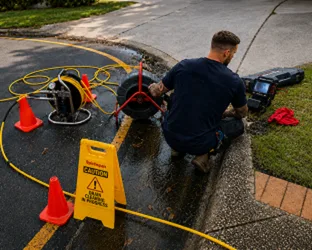
Acoustic listening, thermal imaging and section-by-section pressure testing find the actual split, which is rarely under the wet patch.

The damaged section is removed and replaced properly. If what we expose says the whole run is finished, you hear it straight, with prices for both roads.
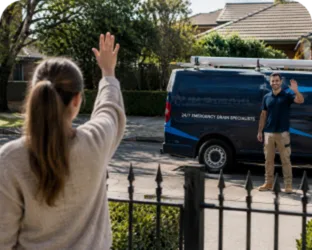
Mains-pressure test before anything closes. The repair demonstrates itself; then, and only then, do surfaces go back.
The hard part is done, the water has stopped. Call, and we plan the repair with you before anything else gets wet.
What people ask us with the water off, answered before you need them.

Water off? Good: now let us get it back on. Fixed price before the repair starts, pressure-tested before we leave.

Leave your details and our local Chifley team will call you back fast.