
The simple locate: $200–$400
Short accessible runs: confirmed, pinpointed, marked without ceremony.
A leak you cannot see is still on the meter, still under the slab, still soaking the wall cavity. We find them with listening gear, thermal imaging and pressure testing, so the repair needs one small hole in the right place, not three big ones in guesses.
A concealed leak cannot keep all three of its secrets. It makes a sound, pressurised water escaping sings in frequencies acoustic gear tracks along the pipe. It changes temperature, the wet path, or the warm plume of a leaking hot line, paints itself across thermal imaging. And it loses pressure, isolate the pipework section by section against a gauge, and the guilty run confesses while the innocent ones hold steady.
One signal narrows it; three signals convict. Where the readings intersect we mark the surface, and that mark is routinely metres from where instinct says to dig, especially under Chifley’s renovated homes, where pipe runs wander in ways no drawing ever recorded. Every centimetre of accuracy is a tile that stays on the floor.


A leak running into sandy ground does not just disappear, it moves material. Over months it can wash fines away from under pavers, a driveway or a slab edge, and the first structural sign is a section that has started to sink.
With the coast and golf links nearby, wind-blown sand and grit find their way into gully traps and drains, gradually choking the flow.
If something outside has settled unevenly and there is no obvious reason, a leak upstream of it is a legitimate suspect and worth ruling out before anything gets relaid.
So close to the ocean, Chifley’s pipes and fittings cop constant salt and moisture that speed up corrosion, cracking and leaks over the years.
A recurring damp problem near the water often has nothing to do with plumbing. Wind-driven rain, a high tide against a low subfloor, and stormwater with nowhere to go all produce moisture that looks like a leak and is not.
The way to tell is timing. Damp that tracks the weather is not plumbing; damp that is constant regardless of conditions usually is. Keep a note of when it appears, it is genuinely useful evidence.
Many of Chifley’s postwar homes still run on original clay and earthenware pipes that crack, sag and let roots in over time. A camera pinpoints the problem.
A persistent sewer smell around a property with no obvious source is worth investigating properly. It usually means either a dry or failed trap, or a break in a line venting where it should not.
A smoke test finds both quickly, introduce smoke into the system and watch where it emerges. It is unglamorous, cheap, and conclusive in a way that sniffing around is not.
In free-draining ground the useful methods are the ones that do not depend on seeing water: isolating sections and watching the meter, listening for the sound a pressurised leak makes through the soil, and tracer gas where acoustics are inconclusive.
It is slower than following a wet patch and far cheaper than excavating on a guess.
Chifley is a quiet coastal suburb in Sydney’s south-east (postcode 2036), tucked between Maroubra, Malabar and Little Bay near the golf links and the ocean. Its postwar homes and salt-air setting make drains a recurring concern here, one we handle every day.
Close to the water the ground is frequently wet regardless of any plumbing fault, which removes the most obvious diagnostic anybody has. Damp subfloor, moisture in the slab edge and standing water in a trench prove nothing here.
So detection near the water leans on isolation and the meter rather than observation, and on tracer gas where a leak is genuinely hidden by ambient groundwater.
Not every escape of water is under pressure. A cracked drain leaks into the ground continuously without affecting the meter, without a pressure drop, and often without a single symptom inside the house.
The distinction decides the method. Pressure leaks are found with acoustics and the meter; drain faults are found with a camera and, where needed, a smoke or dye test.
Short accessible runs: confirmed, pinpointed, marked without ceremony.
First hour with the full kit, pressure isolation, thermal, acoustic, on a typical concealed leak.
Extended runs, awkward access and multi-leak eliminations, beyond hour one.
Deep slab lines and multi-storey tracing at the top of the Sydney range.
Quoted off exactly what detection found, repaired through the marked spot, same crew, same visit, one call-out.
Weigh it against the alternative: exploratory demolition starts at more than detection costs, and it starts in the wrong place. Figures here are indicative of the 2026 Sydney market rather than a quote from us, you get your own number as a fixed price before any work starts.

Meter protocol, bills, history. If the evidence says no supply leak, you hear that for free, not a finding fee for nothing.
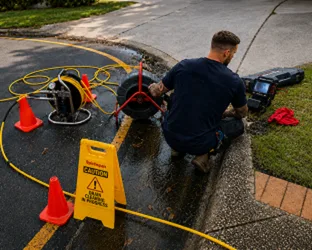
Section-by-section pressure isolation, hot against cold, run against run, until exactly one line owns the loss.

Thermal and acoustic sweeps along the guilty run until the signals stack on one spot. That mark is where, and only where, we open.

Access at the mark, section repaired, pressure re-tested, surface closed. A run in terminal condition gets reroute numbers before, not after.
That is a leak, and it is not fixing itself. Book the detection before it surfaces through something expensive.
Instruments, evidence, one precise repair: and a bill that goes back to normal.

Leave your details and our local Chifley team will call you back fast.